Why You Should Remove That Tree Stump
That leftover stump might seem harmless, but it can attract pests, spread disease, and create hazards. Here is why stump grinding is worth it.
After a tree comes down, the stump is easy to ignore. It's not going anywhere, it's not obviously dangerous, and grinding it out costs extra. So why bother?
Here are six reasons we recommend stump grinding to almost every customer after a tree removal — and why most of them are glad they did it.
1. Stumps Attract Termites and Other Wood-Boring Insects
A rotting stump is prime real estate for termites, carpenter ants, wood-boring beetles, and other insects that feed on decaying wood. The problem isn't just the stump itself — it's that these insects don't stay there.
Once a colony establishes in a stump near your home, it's a short trip to your deck, your fence, your outbuildings, or your house. Termite damage in Virginia averages thousands of dollars per infestation. Stump grinding eliminates the food source before the colony gets established.
2. Stumps Spread Fungal Disease to Other Trees
Many of the fungal diseases that kill trees — including Armillaria root rot, one of the most common tree killers in Virginia — can persist in a dead stump for years and spread through root contact to nearby healthy trees.
If the tree you removed was diseased, leaving the stump in the ground is like leaving a reservoir of infection in your yard. Grinding the stump and removing the chips eliminates that risk.
3. Stumps Are a Tripping Hazard
This one is straightforward. Stumps — especially low ones that get partially hidden by grass — are a tripping hazard for children, guests, and anyone mowing the lawn. They're also a liability issue if someone is injured on your property.
4. Stumps Produce Unwanted Sprouts
Many tree species will send up new sprouts from the stump and root system after the tree is cut down. Oaks, maples, and elms are especially persistent. These sprouts can be vigorous and difficult to control — you'll be cutting them back every season indefinitely unless you remove the stump and treat the roots.
5. Stumps Make Lawn Maintenance Harder
Mowing around a stump is a nuisance. Over time, the stump becomes a focal point for weeds and grass that's difficult to trim. If you ever want to use that area for planting, a garden bed, a patio, or any other purpose, the stump has to go first.
6. Stumps Reduce Your Property's Curb Appeal
A well-maintained yard with a clean, level surface looks better than one with a rotting stump in the middle of it. If you're thinking about selling your home, stumps are one of those small things that buyers notice and factor into their offer.
What Is Stump Grinding?
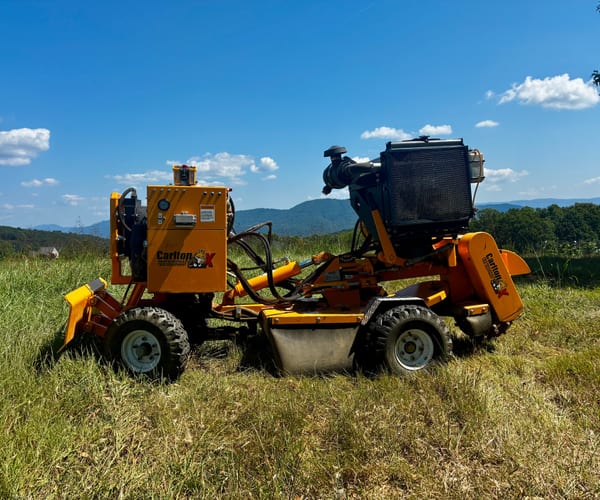
Stump grinding is the most efficient and cost-effective way to remove a stump. A stump grinder uses a rotating cutting wheel to chip the stump and surface roots down below ground level — typically 6 to 12 inches deep.
The result is a pile of wood chips (which can be used as mulch or hauled away) and a level surface that can be seeded with grass or used for planting.
Stump grinding is not the same as stump removal. Full stump removal — pulling the entire root ball out of the ground — is more disruptive and expensive, and rarely necessary for residential properties. Grinding is the right solution in almost every case.
How Deep Do We Grind?
For most residential applications, we grind 6 to 8 inches below grade. This is deep enough to:
- Allow grass to grow over the area
- Prevent regrowth from the stump
- Eliminate the visible hazard
If you're planning to plant a new tree or install a structure in the same spot, let us know — we can grind deeper to give you a clean slate.
What Happens to the Wood Chips?
After grinding, you'll have a pile of wood chips and sawdust where the stump was. You have a few options:
- Use them as mulch — spread them around garden beds or trees (avoid piling them directly against plant stems)
- Leave them to decompose — the chips will break down over a season or two and enrich the soil
- Have them hauled away — we can remove the chips as part of the job if you prefer a completely clean finish
How Much Does Stump Grinding Cost?
Stump grinding is priced based on the diameter of the stump. Most residential stumps in the New River Valley run between $75 and $250 per stump, with discounts available when grinding multiple stumps in the same visit.
The cost is almost always worth it when you factor in the pest control, disease prevention, and lawn maintenance benefits.
Free Stump Grinding Estimates in Blacksburg and the New River Valley
Blue Ridge Tree Specialists grinds stumps throughout Blacksburg, Christiansburg, Radford, Salem, and the surrounding New River Valley. We use professional-grade equipment that can handle stumps of any size, including large hardwoods.
Call (540) 951-1458 for a free estimate. We're happy to assess your stump and give you an honest price with no obligation.
Explore Topics
Written by
Blue Ridge Tree Specialists
Written by the Blue Ridge Tree Specialists team, drawing on more than four decades of local tree-care experience in the New River Valley.